The doctrine of Ichinen Sanzen (Three Thousand Realms in a Single Moment of Life) represents the pinnacle of Buddhist philosophy as systematized by the Great Teacher T’ien-t’ai and emphasized by Nichiren Shonin. This principle clarifies the profound interconnectedness between the individual mind and the entire universe.
Ichinen: Refers to the single “thought-moment” of life.
Sanzen: Refers to the “three thousand” realms, a symbolic number representing the totality of all cosmic phenomena.
The Components of the Three Thousand Realms
The number 3,000 is derived from a meticulous integration of Buddhist concepts found in the Lotus Sutra. It serves to illustrate that no aspect of existence is excluded from a single moment of life:
The Ten Realms (Jukkai): These are the ten subjective states of life that a person experiences:
1. Hell
2. Hungry Ghosts
3. Animals
4. Ashura
5. Humans
6. Heavenly Beings
7. Sravakas
8. Pratyekabuddhas
9. Bodhisattvas
10. Buddhahood.
Mutual Possession (Jukkai Gogu): The principle that each of the Ten Realms contains the other nine within it, meaning Buddhahood is inherently present even in the lowest states (10 Realms x 10 Reams = 100 Worlds).
The Ten Factors (Junyoze): The qualities through which life is expressed, such as appearance, nature, entity, power, activity, primary causes, environmental causes, effects, rewards and retributions, and equality (100 Worlds x 10 Factors = 1,000 Factors).
The Three Realms of Existence (San-seken): The realm of the individual (physical and mental aspects), the realm of living beings (the social context and interactions with others), and the environment (the physical world) (1,000 Factors x 3 Realms = 3,000 Realms).
The Philosophical Implications
The Oneness of Life and Environment (Esho Funi)
Because the “Three Realms of Existence” are included in the calculation, Ichinen Sanzen proves that our environment is not separate from us. It is an extension of our internal life-state. If the Ichinen (the single moment of life) changes, the Sanzen (the three thousand realms/the environment) must also change.
The Reality of Buddhahood
Before this doctrine, Buddhahood was often seen as a distant state or a different location. Ichinen Sanzen teaches that Buddhahood is a physical and mental reality present in this world, in this body, and in this moment.
In Buddhist philosophy, Karma refers to “action”—the cumulative influence of our thoughts, words, and deeds. Every action leaves an imprint upon the deepest levels of our existence. In the Nichiren tradition, we view these not as external judgments, but as internal “seeds” stored within the depths of our life. When these internal causes meet with the appropriate external conditions, they manifest as the physical and emotional circumstances we experience.
Far from being a static “fate” or a system of divine punishment, the law of causality is a dynamic process. While the past cannot be changed, the meaning of that past—and its future trajectory—is entirely dependent on the present moment.
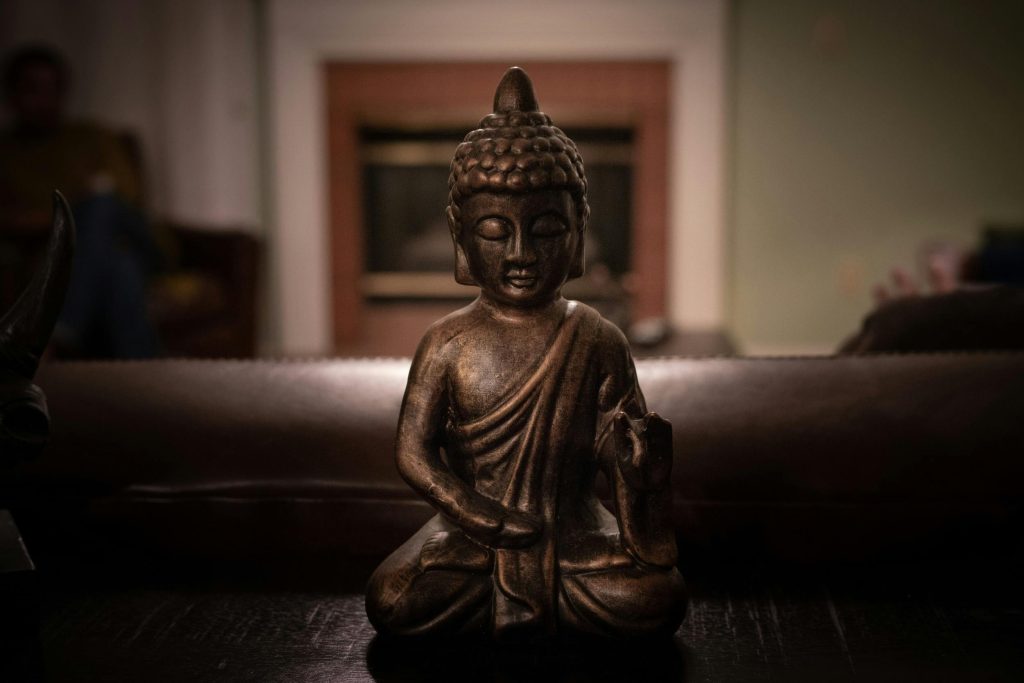
Photo by Sergei Starostin
The Shift from Passive to Active
A common misconception is that karma is a burden to be passively endured until its energy is exhausted. Nichiren Buddhism emphasizes a proactive approach, and this involves a fundamental shift in the practitioner’s perspective:
The Recognition of Causality: Acknowledging that current hardships are the manifestation of causes created within the “Ten Realms” of our own lives. This provides a logical framework for understanding suffering without falling into despair or blame.
The Vow of the Bodhisattva: The practitioner views their specific struggles—whether physical, financial, or emotional—as a deliberate “expedient means.” By resolving to overcome these obstacles through the power of the Dharma, the practitioner turns a personal grievance into a public demonstration of Buddhist principles.
The Alchemy of Chanting
The practice of chanting Namu Myoho Renge Kyo is the means by which we tap into the Nine Consciousnesses—the pure, undefiled consciousness of the Buddha. This level of life exists beneath the layers of our personal and family karma.
Chanting is often likened to sunlight melting ice; the “ice” of negative karma does not simply vanish but is transformed into the “water” of wisdom and compassion. By anchoring our lives in this pure state, we rewrite our destiny.
When an individual makes the transition from being a victim of their circumstances to being a “protagonist” of their own mission, the nature of their karma changes. The struggle is no longer a debt being paid; it is a tool being used to guide others toward enlightenment.
If one wishes to understand the causes created in the past, they can be seen in the results manifested in the present. Likewise, future results can be understood by examining the causes being made now – Paraphrased from Nichiren Shonin’s Writings, The Opening of the Eyes
In our first steps toward understanding Buddhism, we often encounter the Four Noble Truths. Think of these as a medical diagnosis: identifying a problem, finding the cause, confirming a cure exists, and following the prescription.
Photo by Sunilkumar Krishnamoorthy
1. The Truth of Suffering
Suffering is an inescapable part of the human experience. This includes obvious pain like illness and loss, but also the subtle “unsatisfactoriness” we feel when things change or don’t go our way. In Nichiren Shu, we don’t ignore this; we acknowledge it as the starting point of our practice.
2. The Truth of the Cause of Suffering
The root of our suffering is often attachment and craving. We want things to stay the same when they are naturally changing, or we chase external things thinking they will bring permanent happiness.
3. The Truth of the End of Suffering
The “Good News” of Buddhism is that suffering can be overcome. We can achieve a state of peace and enlightenment (Nirvana) by shifting our perspective and awakening to our true Buddha nature.
4. The Truth of the Path
The “prescription” for ending suffering is the Eightfold Path. In our Nichiren Shu tradition, we believe that by chanting Namu Myoho Renge Kyo, we encompass the essence of this path, allowing us to face life’s hardships with wisdom and courage.
Key Takeaway: Buddhism isn’t about escaping life; it’s about transforming our suffering into a source of strength.
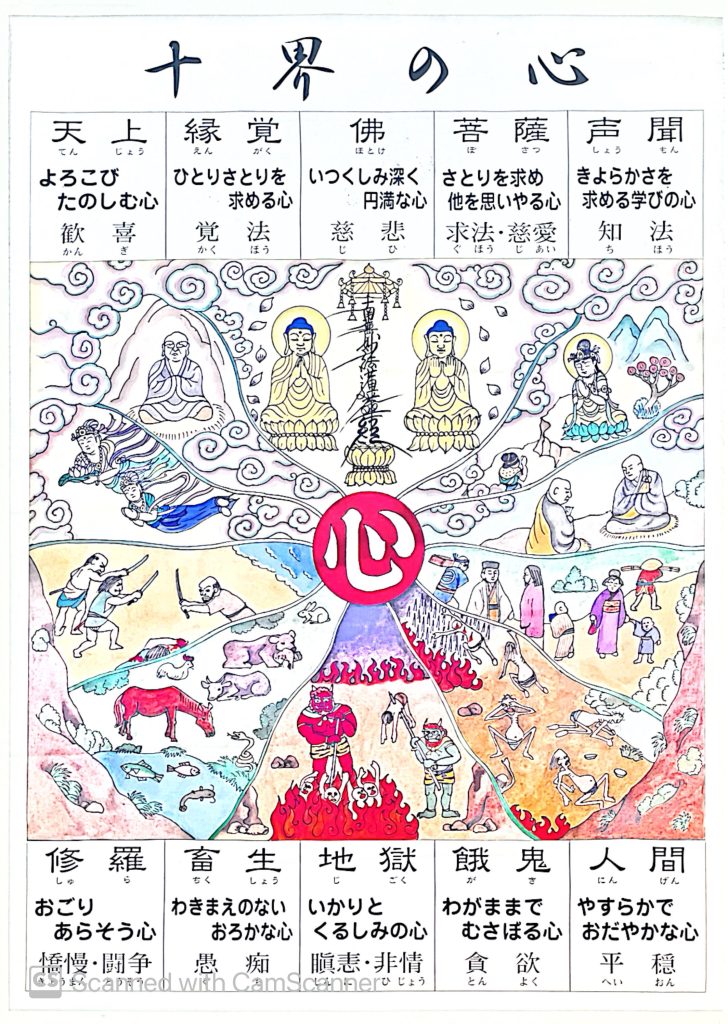
In Buddhist philosophy, particularly within the Tiantai (Tendai) and Huayan (Kegon) schools, the concept of the Ten Realms (十界 – shí jiè) offers a profound framework for understanding the diverse conditions of life and the various states of mind we experience. These realms are not necessarily physical places, but rather internal states, external environments, and potential future existences that all beings can inhabit, traverse, and even transform.
Nichiren Buddhism (including Nichiren Shu) emphasizes this concept deeply, asserting that all ten realms exist simultaneously within every moment of life, a principle known as The Mutual Possession of the Ten Worlds (十界互具 – jikkai gogu). This means that even the state of Buddhahood is inherent in a person experiencing the torments of Hell, and vice versa. Our current state is determined by the dominant thought or condition of our lives at any given moment.
The teaching of the Ten Realms provides a powerful lens through which to examine our own lives, cultivate compassion, and work towards enlightenment. Let’s explore each of these realms:
In Buddhist philosophy, particularly within the Tiantai (Tendai) and Huayan (Kegon) schools, the concept of the Ten Realms (十界 – shí jiè) offers a profound framework for understanding the diverse conditions of life and the various states of mind we experience. These realms are not necessarily physical places, but rather internal states, external environments, and potential future existences that all beings can inhabit, traverse, and even transform.
The teaching of the Ten Realms provides a powerful lens through which to examine our own lives, cultivate compassion, and work towards enlightenment. Let’s explore each of these realms:
Credit: Photo sourced and scanned from a picture at Penang Nichiren Shu Buddhist Association
The Six Lower Realms (Paths of Suffering)
These realms are often characterized by suffering and are considered less desirable states of existence, driven by delusion and negative karma.
1. The Realm of Hell (地獄界 – dìyù jiè)
This is the lowest and most agonizing realm, characterized by intense suffering, pain, and despair. It represents a state of overwhelming anger, hatred, and self-torment. While it can manifest as literal hellish existences, it also signifies the experience of extreme mental anguish, guilt, and resentment in our current lives.
2. The Realm of Hungry Ghosts (餓鬼界 – èguǐ jiè)
In this realm, beings suffer from insatiable cravings and desires, constantly seeking fulfillment but never finding satisfaction. They are plagued by spiritual and emotional hunger. This can be seen in our lives as addiction, greed, and a perpetual feeling of emptiness, always wanting more but never feeling truly content.
3. The Realm of Animals (畜生界 – chùshēng jiè)
This realm is characterized by instinctual behavior, ignorance, and a lack of self-awareness. Beings in this realm are often driven by survival, fear, and desire, without much capacity for moral discernment or spiritual growth. In human terms, it can represent a life lived purely by instinct, without reason or compassion, or being exploited by others.
4. The Realm of Ashura (阿修羅界 – āxiūluó jiè)
Also known as the “fighting spirits” or “demi-gods,” Ashuras are powerful but perpetually engaged in conflict, jealousy, and pride. They are driven by a desire for dominance and recognition, often feeling competitive and angry. This realm reflects states of intense rivalry, arrogance, and a constant struggle for superiority, even when endowed with power or wealth.
5. The Realm of Humans (人間界 – rénjiān jiè)
This is our current realm, characterized by a balance of suffering and joy. Humans have the unique capacity for both good and evil, wisdom and ignorance. It is considered a crucial realm because it offers the greatest opportunity for spiritual awakening and understanding the Dharma, due to our ability to reason, make choices, and pursue enlightenment.
6. The Realm of Heavenly Beings (天界 – tiān jiè)
These are realms of pleasure, happiness, and comfort, inhabited by “gods” or celestial beings who have accumulated much positive karma. However, even this realm is temporary; when their good karma is exhausted, they will fall into lower realms again. This represents states of fleeting joy, luxury, and temporary freedom from suffering, but without the ultimate liberation of enlightenment.
The Four Noble Realms (Paths of Enlightenment)
These realms represent states of mind and existence that lead towards liberation and enlightenment, transcending the cycle of suffering.
7. The Realm of Sravakas (声聞界 – shēngwén jiè)
Sravakas, or “Voice-Hearers,” are those who hear the teachings of a Buddha and strive to attain individual liberation by eliminating delusions and attachment. They achieve a state of personal peace and insight, primarily focusing on their own spiritual development. This represents a stage of initial understanding and practice of the Dharma.
8. The Realm of Pratyekabuddhas (縁覚界 – yuánjué jiè)
Pratyekabuddhas, or “Solitary Buddhas,” attain enlightenment independently, often through observing the principle of dependent origination and the impermanence of life, without a direct teacher or guiding Buddha in their lifetime. They achieve a deeper level of insight than Sravakas but generally do not teach others. This signifies profound individual realization, often through introspection and observation of nature.
9. The Realm of Bodhisattvas (菩薩界 – púsà jiè)
Bodhisattvas are enlightened beings who have vowed to postpone their own final nirvana to help all other sentient beings achieve enlightenment. They embody boundless compassion and wisdom, actively working to alleviate suffering in the world. This realm represents the highest ideal of Mahayana Buddhism, characterized by altruism, selflessness, and the commitment to universal salvation.
10. The Realm of Buddhahood (佛界 – fó jiè)
This is the highest and ultimate realm, the state of perfect and complete enlightenment. A Buddha is one who has fully awakened to the ultimate truth of the universe, transcended all suffering, and possesses infinite wisdom, compassion, and courage. This realm represents the ultimate goal of Buddhist practice, a state of absolute freedom, peace, and pervasive wisdom that is inherent in all beings.